Chimney Repair & Masonry Restoration in Schenectady, New York
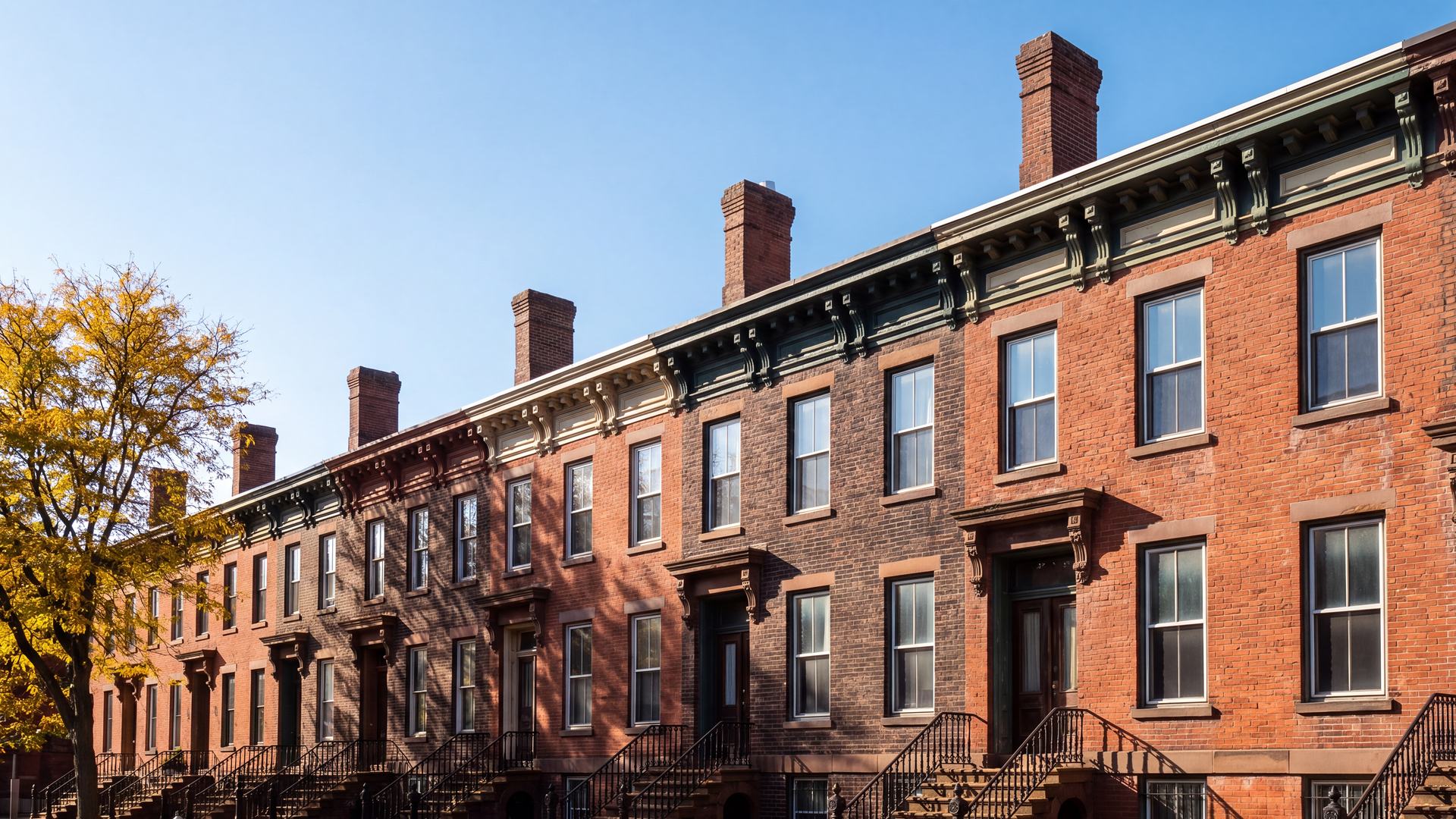
The Stockade, where Schenectady began, was founded by the Dutch in 1661 on land purchased from the Mohawk. A massacre and fire destroyed the village in 1690, and the neighborhood that grew back has stayed mainly residential, keeping a diverse architectural legacy of houses, churches, and public buildings. Elsewhere in the city, the GE Realty Plot traces to 1899, when Union College announced the sale of two adjacent, undeveloped tracts; by 1927 roughly a hundred houses stood there. Both neighborhoods carry chimneys that have stood through generations of Capital Region winters, on houses whose street faces are part of the historic record.
What goes wrong with those chimneys is the same list that drives chimney repair throughout the Capital Region, made more delicate by age: crowns that are often just a sand-and-mortar wash, joints worn sandy by freeze-thaw, spalled brick in the top courses, and flues built for coal or wood that may now vent modern equipment. Niskayuna, also in Schenectady County, adds newer layers: its Country Club area was developed between the 1920s and 1940s, the Middle Street area mixes 1940s homes with newer, larger ones, Rosendale Estates was approved in the late 1940s and first built out in the 1950s, and Avon Crest grew during and after the 1950s. On chimneys from those decades, the crown, the flashing, and the clay flue tiles are the first things to have checked.
free quotes, no obligation; requests go to an independent local contractor.
Free quote
Chimney Work in New York's First Historic District
In 1962 the city council established the Stockade as a historic district, the first in New York State, and in 1973 it was entered on the National Register of Historic Places. That status shapes chimney repair there more than any material does. The city's historic-resources article does not prevent ordinary maintenance and repair that involves no change in design, material, color, or outward appearance, so the simplest path is a repair nobody can see afterward: brick matched in size and color, repointing matched to the old mortar in color, texture, and joint profile (on masonry this old, usually a soft, lime-rich mix), and a crown and cap that read like the originals.
The same article cuts the other way too. It bars owners from letting a historic resource fall into serious disrepair, and its examples include deterioration of exterior chimneys, crumbling mortar, and ineffective waterproofing. In the regulated districts, a spalling stack or an open crown is therefore not just a maintenance item to put off; it is a condition the code itself names. Catching it while a matched repoint or a like-for-like crown repair will still do makes it more likely the work stays ordinary maintenance, and keeps a rebuild of failed courses the exception rather than the plan.
The GE Realty Plot raises a different question. Architects including E.K. Rossiter, T.H. Ellet, W.T.B. Mynderse, and A.J. Russell designed houses there, and in 1980 the whole neighborhood was listed on the National Register. That listing alone does not settle whether the city's review applies; the answer turns on whether the address sits in one of the regulated districts, so check with the city before anyone orders brick. Either way, an architect-designed house deserves a chimney repair that keeps its original corbels, cap profile, and brick color.
See Schenectady, NY on Google Maps — quote requests from across the area go to independent local contractors.
What Drives Chimney Repair Costs in Schenectady
Schenectady quotes rest on the usual basics (how much masonry has failed and what it takes to reach it) plus two local factors: matching materials closely enough to stay within ordinary maintenance in the historic districts, and the calendar time a certificate of appropriateness adds when a job needs one. The chimney repair price ranges give the numbers; these are the city and Niskayuna conditions behind a quote.
- In-kind materials: brick sourced for size and color, mortar mixed and tooled to the old joints, and cap details that look original take more sourcing and labor than commodity materials.
- Review steps: in the regulated districts, exterior work in public view that needs a building permit also needs a certificate of appropriateness, which adds an application and a wait before the mason can start.
- Permit-triggering work: the City Code names installing a solid-fuel heating appliance, chimney, or flue as permit work, so a new woodstove or a stainless liner for an old flue may bring permit and inspection steps that a repoint does not.
- Crown condition: a sand-and-mortar wash that has cracked through generally calls for replacement rather than a coating, and a cast crown with an overhang, drip edge, and bond break costs more than sealing a sound one.
- Postwar Niskayuna chimneys: on a 1950s Rosendale Estates or Avon Crest house, the crown, flashing, and clay flue tiles are the parts to price, and the total climbs when all three come due together.
Permits and Historic Review in Schenectady and Niskayuna
In the city, permits run through the Bureau of Code Enforcement, whose Code Enforcement Officer is appointed by the Mayor and designated as the Building Inspector. City Code section 137-4A requires a building permit for any work that must conform to the Uniform Code or the Energy Code, specifically including the installation of a solid-fuel-burning heating appliance, chimney, or flue in any dwelling unit. Section 137-4B exempts repairs only if they do not involve removing or cutting away load-bearing components, changing required egress, altering, replacing, or relocating a building system, or taking fire protection out of service. Whether a relining or partial rebuild needs a permit is the Bureau's call, so ask before the job is scheduled; pulling the permit is normally the contractor's task.
Historic review belongs to the Historic Resource Commission, and the regulated districts are the RH-2 Stockade Historic Residential District, the RH-1 Historic Residential District, and the OH Overlay Historic District. A certificate of appropriateness is needed for exterior alteration, restoration, repair, reconstruction, or demolition that requires a building or demolition permit and is in public view, which the code defines as highly visible or visible from customarily public spaces such as streets and parks. Another clause covers installing, removing, replacing, or changing the materials of exterior architectural features, naming roofs among them. A chimney top seen from the street meets the public-view test easily.
Niskayuna works differently. Its Building Department, headed by the Senior Building Inspector, issues permits for the erection, alteration, removal, and demolition of buildings, and Town Code section 75-4A exempts ordinary non-structural repairs, along with work the Uniform Code itself exempts. The town's Historic Preservation Committee serves in an advisory capacity to the Town Board and the planning, zoning, and architectural review boards, recommending areas that should become town historic districts; its page names no designated district. A liner, a new stove, or rebuilt courses still deserve a call to the Building Department before work begins.
Chimney Services Available in Schenectady
Every chimney and fireplace service on this site is available to Schenectady homeowners. Each page explains the work, the signs that call for it and typical pricing:
See the full pricing guide for typical ranges.
Schenectady FAQs
Do I need a permit for chimney repair in Schenectady?
It depends on the scope. Installing a solid-fuel heating appliance, chimney, or flue is named permit work, and repairs are exempt only when they leave load-bearing parts, egress, building systems, and fire protection alone. Ask the Bureau of Code Enforcement which side a given chimney job falls on before work starts; the contractor normally handles the application.
Does a Stockade chimney repair need Historic Resource Commission approval?
If it needs a building or demolition permit and can be seen from a street or other public space, yes, and changing or replacing exterior features also calls for a certificate of appropriateness. Ordinary maintenance that keeps the design, material, color, and outward appearance unchanged is not blocked by the historic-resources article, which is why matching brick and mortar closely matters so much in the RH-2 district.
Should a chimney be inspected before buying a house in the Stockade or the GE Realty Plot?
Yes. Under the NFPA 211 inspection levels as CSIA describes them, a sale or transfer of property calls for a Level 2 inspection, which adds accessible attics, crawl spaces, and basements to the basic check. On an old house it shows, before closing, whether the flue is lined and clear of creosote, whether the crown is a wash or cast, and whether the stack shows deterioration the historic-resources article names; the chimney inspection and sweeping page explains the visit.
Is chimney work in Niskayuna subject to historic review?
Not in the way Stockade work is, as far as the town's own pages show: the Historic Preservation Committee is advisory, and it names no designated town historic district. The practical questions belong to the Building Department, where ordinary repairs that are not structural are exempt; relining, a new appliance, or rebuilding courses should be confirmed with the department first, along with any special status your property may have.
Get Your Free Schenectady Quote
Free quote